
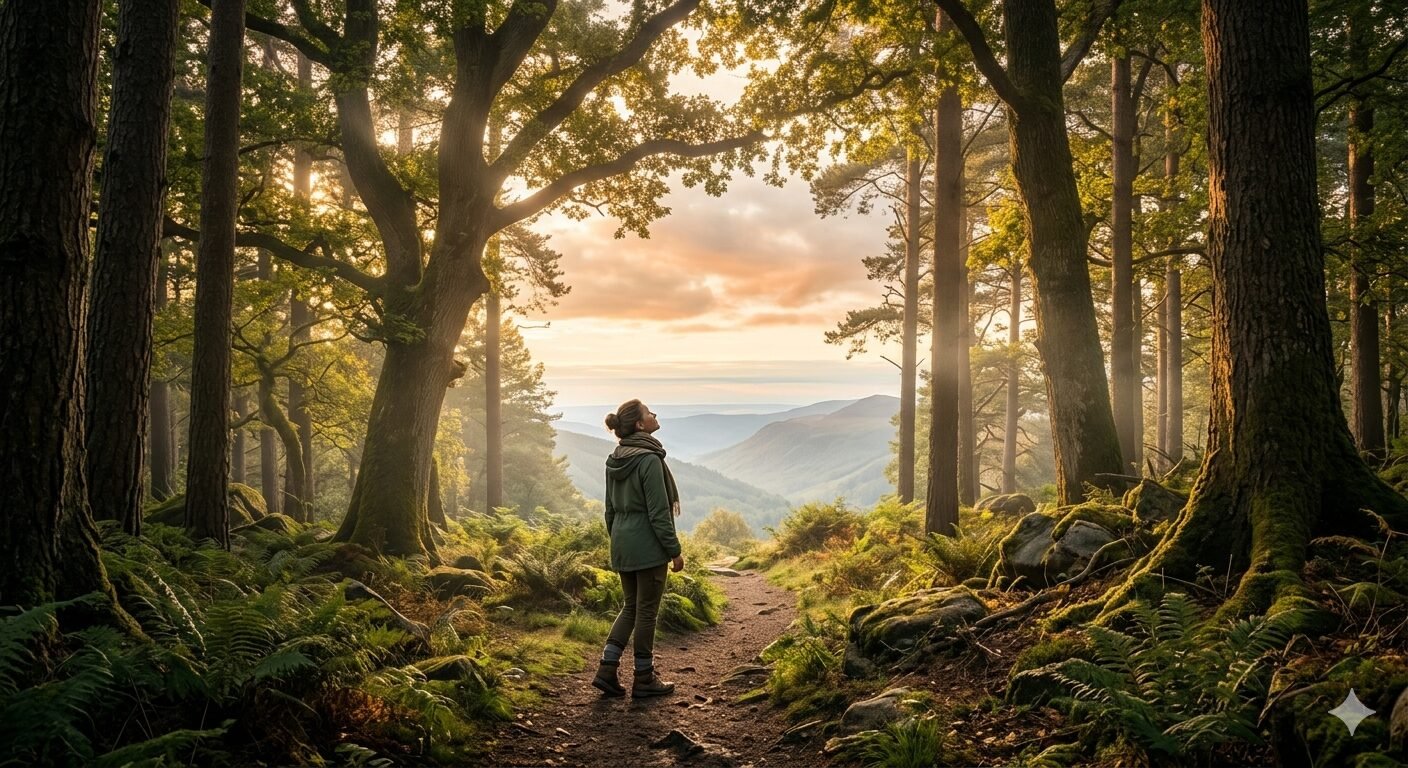
Maybe it happens when you stand beneath a cathedral of trees and the light moves through the leaves like liquid gold. Maybe it happens when you look out across the sea and realize the horizon does not care about your inbox, your deadlines, or the loop of anxious thoughts running through your mind. In that instant, something softens. The grip of the self loosens. You feel smaller, but strangely, you also feel freer.
That is the promise of an awe walk.
An awe walk is not just a pleasant stroll. It is a deliberate practice of noticing vastness, beauty, surprise, and pattern in the world around you. Research suggests that weekly awe walks can increase positive emotions, reduce distress, and shift attention away from self-focused rumination toward a broader, calmer perspective. Nature-based walking also shows meaningful benefits for momentary anxiety and emotional regulation.
What Is an Awe Walk?
An awe walk is a mindful walk where your main goal is not speed, distance, or calories. Your goal is attention.
You notice what feels vast, unexpected, intricate, or quietly beautiful. That could be a skyline, a tree trunk, a puddle reflecting the sky, the architecture of an old building, or even the resilience of a weed growing through concrete. The point is to shift from “What am I thinking?” to “What is here?”
The idea became widely known through research at UC San Francisco. In one study, older adults who took weekly 15-minute awe walks for eight weeks reported greater positive emotion and less daily distress, and their photos showed a stronger outward focus over time.
A gentle companion article on mindfulness for beginners can help deepen this practice.
Why Awe Walks Can Help Anxiety
Anxiety often narrows the mind.
It pulls attention inward, then turns that inwardness into a courtroom. Thoughts repeat. Scenarios multiply. The body stays alert as if danger were nearby, even when the danger is only imagined. Awe works in the opposite direction. It widens attention, reduces self-absorption, and creates psychological breathing room.
That widening matters because awe has been associated with greater joy, compassion, gratitude, and lower distress. In the weekly awe-walk study, participants experienced stronger prosocial positive emotions over time, which means the practice did not merely distract them. It seemed to shift their emotional orientation.
For someone living with anxiety, this can feel almost paradoxical. You do not fight the mind by clenching harder. You ease the mind by helping it notice something larger than its own spiral.
The Science of Awe, the Small Self, and the Nervous System
The science behind awe is more than poetic language. It is a real research field now.
A major review describes awe as working through several pathways: changes in neurophysiology, reduced self-focus, greater social connection, stronger meaning, and broader prosocial orientation. In plain English, awe helps move the mind from “me, my problem, my fear” toward “I am part of a larger pattern.” That shift can be emotionally regulating and physically grounding.
Researchers also describe a “small self” effect. This does not mean becoming less important. It means the self becomes less inflated in the center of everything. Worries lose a little of their throne. The mind becomes less trapped in its own echo chamber. That is why awe can feel both humbling and relieving at the same time.
Nature appears to be one of the most reliable triggers for awe. A systematic review of nature walks found evidence of reduced state anxiety, meaning the immediate feeling of anxiety at the moment can ease after walking in natural settings. This is not a miracle cure, but it is a meaningful, accessible tool.
If breathing exercises help you settle, this article fits beautifully alongside awe walking.
Your Day is Won or Lost in the First and Last Hour: A Guide to Intentional Morning & Evening Rituals
How to Take Your First Awe Walk
You do not need a forest, a mountain, or a perfect mood.
You need intention, attention, and a route with something worth noticing.
1. Choose a place with texture
Pick a park, a tree-lined street, a quiet neighborhood, a waterfront, or even a city route with interesting architecture. Awe can live in grand scenery, but it also lives in small details.
2. Walk slower than usual
Awe does not rush. Give yourself 10 to 20 minutes. Let the walk become an experience, not a task.
3. Put your phone away
You can carry it for safety, but do not let it become the narrator. No scrolling, no messages, no podcasts. Your task is to receive, not to consume.
4. Use the “three wonders” method
- one thing that feels beautiful
- one thing that feels vast
- one thing that feels intricately designed
This simple frame helps your attention stay awake.
5. Notice with your senses
- What do I hear?
- What do I smell?
- What patterns do I see?
- What feels larger than me right now?
Awe is not only visual. It can arrive through sound, texture, light, wind, and silence.
6. End with a short reflection
After the walk, write down three things you noticed and one emotion you felt. The Harvard summary of the awe-walk study emphasized that participants became more outwardly focused and experienced less distress over time. Reflection helps lock in the shift.
Finding Awe in Ordinary and Urban Places
You do not need the Grand Canyon to feel awe.
Awe can appear in the city if you know where to look. It can hide in the tops of buildings, the rhythm of a bridge, sunlight on glass, the patience of an old tree, or the kindness of a stranger. Urban awe is real awe. It just wears different shoes. This matters because many people assume that healing requires travel, nature, or dramatic beauty. Often, it simply requires a more attentive gaze.
Try looking for:
- architecture that makes you look up
- nature surviving in small cracks
- human kindness in motion
- light changing on walls, windows, or pavement
- patterns in leaves, wires, shadows, and water
Digital overload can crowd out awe. This related article pairs well with the practice of stepping outside and looking up.
What to Do When You Do Not Feel Like Walking
This is where the practice becomes real.
When anxiety is high, resistance often rises with it. The mind says, stay here, do not move, do not bother, do not add another thing. That is exactly when a tiny awe walk can matter most.
Start absurdly small.
Tell yourself you only have to walk for two minutes. Step outside and look at the sky. Notice one tree. Notice one color. Notice one shape. Many people find that once movement begins, the nervous system softens enough to continue.
The goal is not discipline in the harsh sense. The goal is gentle re-entry into the world.
Recommended Tools for Better Awe Walks
You do not need gear for an awe walk, but a few simple tools can deepen the experience.
1. A small pocket notebook
This is useful because awe walks become more powerful when you record what you notice. A compact notebook helps you capture one detail, one phrase, or one feeling before it dissolves. A good pocket notebook is not glamorous, but it is effective. It turns the walk into a lived practice instead of a passing mood.
2. Compact binoculars
Binoculars help you explore birds, tree canopies, distant details, and architectural features you might otherwise miss. They are especially valuable if your awe walks happen in parks, open landscapes, or coastal areas. A small pair adds curiosity without making the experience feel technical or heavy.
Common Mistakes That Reduce the Effect
Awe walks are simple, but a few habits can flatten them.
Turning it into exercise only
If you focus only on steps and speed, you may miss the emotional medicine. Let the walk be spacious.
Forcing awe
You do not need to manufacture a spiritual revelation. Sometimes awe is a thunderstorm. Sometimes it is a leaf turning in the wind.
Staying trapped in analysis
If you spend the whole walk judging whether you are doing it right, you have accidentally turned the walk back into anxiety.
Expecting instant transformation
Some walks will feel ordinary. That does not mean they failed. Repetition is what teaches the brain to look outward instead of inward.
Why Awe Walks Fit Holistic Wellness So Well
Holistic wellness works best when it treats the human being as more than a problem to fix.
Awe walks fit that philosophy beautifully because they work through body, mind, attention, emotion, and environment at the same time. They are gentle, free, and repeatable. They do not require perfection, just participation. That makes them ideal for people who want a wellness habit that feels human, not industrial.
In that sense, an awe walk is more than a stroll. It is a reset of perspective. A soft rebellion against the tyranny of inner noise.
Conclusion
Feeling small is not always a weakness. Sometimes it is relief.
When you stand before something vast, beautiful, or quietly astonishing, your anxiety loses some of its grip. The mind stops orbiting itself. The body relaxes. The world becomes larger again, and with that largeness comes perspective.
Research suggests that weekly awe walks can increase positive emotions, reduce distress, and support a broader, calmer emotional state. Nature walks also show promise for easing momentary anxiety. The evidence is encouraging, the method is simple, and the cost is almost nothing.
So this week, step outside with one intention: look for something that makes you pause.
Not because you are broken, but because you are alive.
Send this article to someone who needs a breath of fresh air, or keep it as a quiet reminder for your own next walk.
References
- UC San Francisco. “Awe Walks Boost Emotional Well-Being.”
- Harvard Health Publishing. “Awe walks inspire more joy, less distress.”
- Sturm, V. E., et al. “Big Smile, Small Self: Awe Walks Promote Prosocial Positive Emotions in Older Adults.” Emotion.
- Monroy, M., & Keltner, D. “Awe as a Pathway to Mental and Physical Health.”
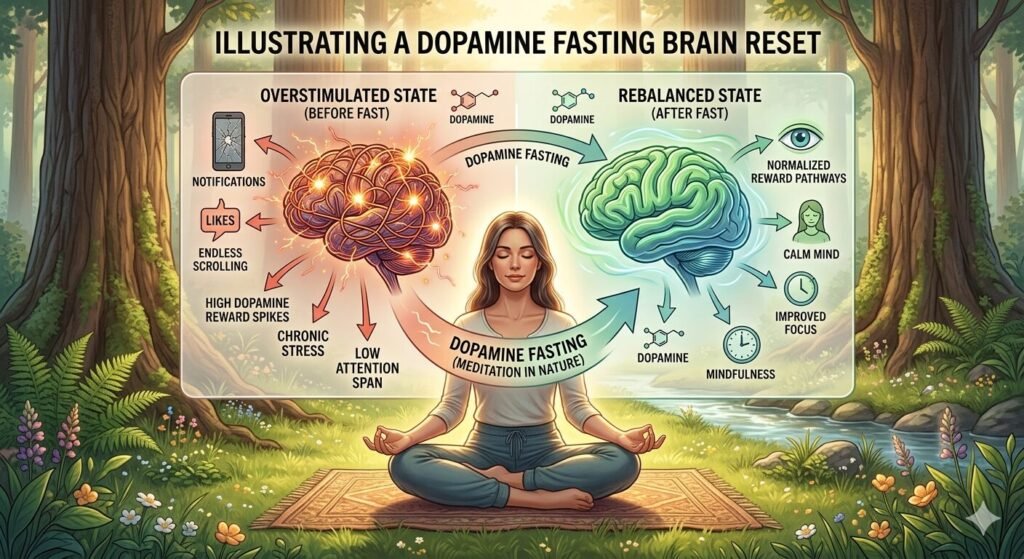
Feeling Unmotivated and Bored? A Beginner’s Guide to Dopamine Fasting to Reset Your Brain’s Reward System
Feeling Unmotivated and Bored? A Beginner’s Guide to Dopamine Fasting to Reset Your Brain’s Reward…
Feeling Tired After Resting? You Might Need “Active Rest” Instead of the Couch
Feeling Tired After Resting? You Might Need “Active Rest” Instead of the Couch Feeling Tired…
The Forgotten Habit: How 15 Minutes of “Earthing” Can Reduce Inflammation and Calm Your Mind
The Forgotten Habit: How 15 Minutes of “Earthing” Can Reduce Inflammation and Calm Your Mind…
Stuck in Overthinking? A Simple 3-Step Formula to Escape Analysis Paralysis
Stuck in Overthinking? A Simple 3-Step Formula to Escape Analysis Paralysis By AsiLotus We live…
Protect Your Peace: Master The Gentle No and Set Boundaries Without
The Gentle No: How to Set Boundaries and Protect Your Peace Without Guilt By AsiLotus…

Is Your Gut Controlling Your Mood? The Secret to a Happier Mind Might Be in Your Stomach l’Gut-Brain Axis
Is Your Gut Controlling Your Mood? — AsiLotus AsiLotus Nov 2025 · 8 min read…

From House to Haven: 7 Simple Steps to Create a Home Sanctuary for Your Soul
From House to Haven: 7 Simple Steps to Create a Home Sanctuary for Your Soul…

The Comprehensive Benefits of a 5-Minute Journaling Habit
Benefits of 5-Minute Journaling — AsiLotus The Comprehensive Benefits of a 5-Minute Journaling Habit Short,…
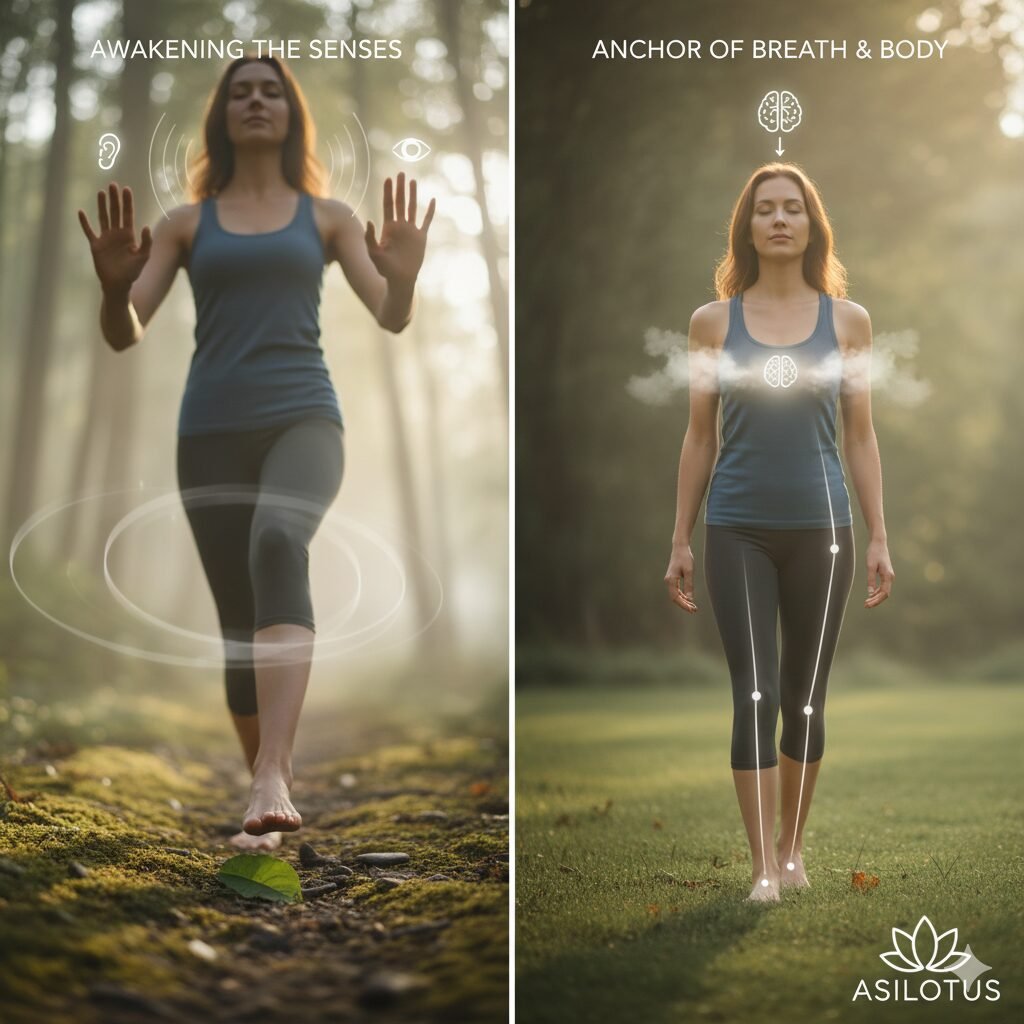
The 10-Minute Miracle: Transform Your Mind with a Daily Mindful Walk
The 10-Minute Miracle: Transform Your Mind with a Daily Mindful Walk Mindfulness · 10-minute routine…

Beyond Burnout: How to Beat Decision Fatigue and Reclaim Your Mental Energy
Beat Decision Fatigue: Overcome Burnout & Reclaim Mental Energy Beyond Burnout: How to Beat Decision…
Your Day is Won or Lost in the First and Last Hour: A Guide to Intentional Morning & Evening Rituals
Holistic Wellness · Rituals Your Day is Won or Lost in the First and Last…
Digital Detox: Reclaiming Your Calm in a Connected World
Digital Detox: Reclaiming Your Calm in a Connected World In a world buzzing with notifications,…