
Feeling Unmotivated and Bored? A Beginner’s Guide to Dopamine Fasting to Reset Your Brain’s Reward System
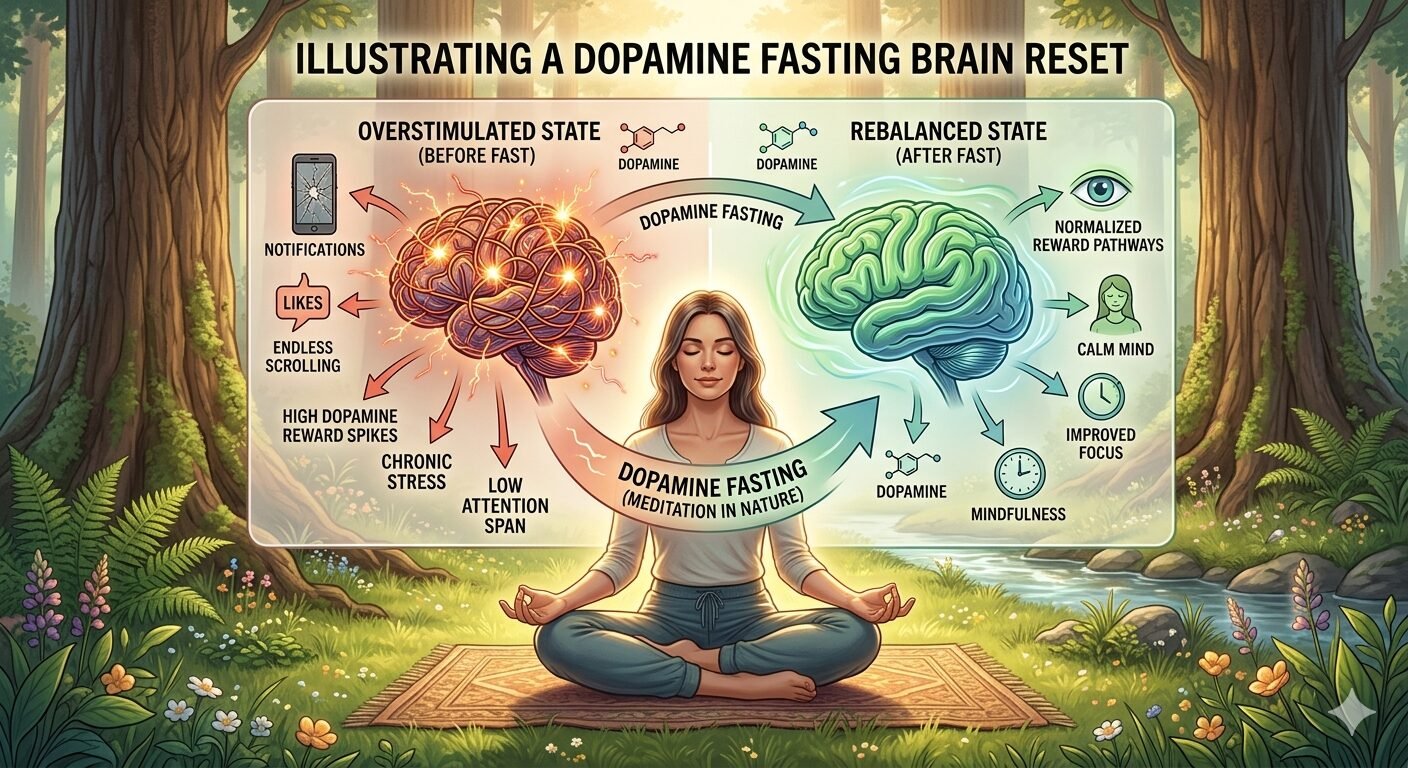
In the contemporary landscape of high-speed connectivity and instant gratification, many individuals find themselves trapped in a paradoxical state of mental exhaustion and persistent boredom. Despite being surrounded by an unprecedented abundance of digital entertainment and information, a growing number of people report a profound sense of “numbness”—a state where activities that once sparked joy, such as reading a physical book, engaging in deep conversation, or simply walking in nature, now feel dull and unrewarding. This modern malaise is not merely a lack of willpower; it is a direct consequence of the systematic overstimulation of the brain’s reward circuitry by engineered digital experiences.
The practice of Dopamine Fasting has emerged as a strategic, evidence-based intervention designed to address this neurological imbalance. Contrary to popular misconceptions, this technique is not about the literal elimination of the neurotransmitter dopamine from the biological system. Instead, it is a deliberate cognitive-behavioral approach focused on the temporary cessation of impulsive, high-intensity behaviors that provide immediate but fleeting satisfaction. By implementing these periods of restraint, individuals can recalibrate their neurological sensitivity to pleasure, ultimately regaining their focus, productivity, and sense of purpose in a world designed to distract them.
1. The Scientific Foundation of Dopamine Fasting
It is essential to clarify the terminology surrounding “Dopamine Fasting” to avoid common scientific pitfalls. Dopamine is a fundamental neurotransmitter that facilitates a wide range of critical functions, including motor control, executive function, memory, and—most importantly for this discussion—motivational drive. It is the chemical signal that tells the brain that a particular activity is worth repeating. Without dopamine, the human experience would lack the “spark” necessary to pursue goals, solve problems, or even seek basic survival needs.
The term, as formalized by Dr. Cameron Sepah in the Dopamine Fasting 2.0 protocol, refers to a structured framework designed to manage impulsive behaviors. These behaviors typically involve activities that provide a “high” of instant gratification followed by a “crash” of lethargy and dissatisfaction. From the perspective of holistic wellness at asilotus.com, we view this process as a recalibration rather than a “detox.” When the brain is chronically exposed to “super-normal stimuli”—such as algorithmic social media feeds, immersive video games, and hyper-palatable processed foods—it undergoes a process of downregulation. This is the brain’s way of protecting itself from overstimulation by reducing the number of active dopamine receptors. By temporarily withdrawing from these high-intensity triggers, we allow the brain to restore its natural baseline, making the subtle and meaningful experiences of life rewarding once again.
, the brain immediately activates an equal and opposite reaction to bring us back to baseline. This “anti-reward” system is what causes the feeling of emptiness or craving once the initial high fades.</p>
<p>In our natural evolutionary environment, dopamine spikes were rare and required significant effort to achieve. For example, finding a source of ripe fruit or successfully completing a hunt would trigger a reward. Today, however, the digital landscape acts as a powerful external heat source placed directly next to the thermostat. When we engage in high-dopamine activities, the “temperature” spikes so rapidly and frequently that the sensors on the thermostat—the dopamine receptors—begin to shut down or “downregulate” to prevent neurological damage.</p>
<p>As a result, your baseline “normal” state becomes one of chronic dissatisfaction. You require more and more stimulation just to feel “okay,” a phenomenon known as the “hedonic treadmill.” By engaging in a Dopamine Fast, we are essentially turning off the external heat source. This allows the receptors to become sensitive once more, lowering the threshold for pleasure and allowing the “quiet” rewards of life—like a sunset, a good book, or a meaningful conversation—to feel deeply satisfying again.</p>
<h2><span class="ez-toc-section" id="4-a-strategic-framework-for-the-beginners-reset"></span>4. A Strategic Framework for the Beginner’s Reset<span class="ez-toc-section-end"></span></h2>
<p>For those beginning their journey into neurological recalibration, it is vital to approach the process with a structured plan. Extreme isolation is often counterproductive and can lead to a “rebound” effect where the individual returns to their old habits with even greater intensity. Instead, we recommend a tiered approach that allows for gradual adaptation.</p>
<div class="table-wrap">
<table>
<thead>
<tr>
<th>Protocol Level</th>
<th>Recommended Duration</th>
<th>Core Restrictions</th>
<th>Permitted Activities</th>
</tr>
</thead>
<tbody>
<tr>
<td>Level 1: The 24-Hour Reset</td>
<td>One full day (e.g., Sunday)</td>
<td>Total screen avoidance (phone, TV, PC), processed sugars, and podcasts.</td>
<td>Journaling, nature walks, meditation, stretching, and deep social interaction.</td>
</tr>
<tr>
<td>Level 2: The Evening Taper</td>
<td>Daily (8:00 PM – Sleep)</td>
<td>Digital devices and high-intensity entertainment after a set hour.</td>
<td>Reading physical books, light housework, and preparation for restorative sleep.</td>
</tr>
<tr>
<td>Level 3: The 7-Day Digital Diet</td>
<td>One full week</td>
<td>Restricting social media and gaming to a single 30-minute block per day.</td>
<td>Focusing on deep work, physical exercise, and “slow” hobbies like gardening.</td>
</tr>
</tbody>
</table>
</div>
<p>The primary objective of these protocols is to cultivate “boredom.” While modern society views boredom as a problem to be solved, in the context of wellness, boredom is a fertile ground for creativity and self-reflection. When the mind is no longer being fed a constant stream of external data, it is forced to engage with its own internal processes, leading to profound insights and a renewed sense of agency.</p>
<div class="button-grid">
<a class="button-card" href="https://asilotus.com/the-power-of-sleep-wellbeing/" target="_blank" rel="noopener noreferrer">
<span class="thumb">
<img alt="Related article" src=)
5. Ancillary Tools for Supporting the Reset Process
While the core of a dopamine fast is the reduction of activity, certain physical tools can provide the structure and support necessary to navigate the transition successfully.

One of the most effective tools for this transition is a physical life planner, such as the Legendary Planner – Deluxe Weekly Life Planner. During a period of reduced stimulation, the mind often generates a high volume of creative ideas, suppressed emotions, and new goals. Without a place to capture these, they can lead to anxiety or a feeling of being overwhelmed. A physical planner provides a tactile, non-digital environment to capture these insights, shifting the brain’s focus from passive consumption to active life design. I recommend this specific tool because it incorporates gratitude journals and habit trackers, which are essential for reinforcing the new, “low-dopamine” neural pathways you are trying to build.
Furthermore, for individuals whose professional responsibilities necessitate screen use even during a “diet” phase, Blue Light Blocking Glasses are a vital defensive tool. Artificial blue light emitted by screens mimics daylight, suppressing the production of melatonin and keeping the brain in a state of high-alert overstimulation. By filtering these wavelengths, particularly in the hours leading up to sleep, you can reduce the baseline level of neurological stress and improve the quality of your recovery periods. This simple intervention can make the difference between a restless night and the deep, restorative sleep required for brain repair.
6. The Psychological Impact: Reclaiming Your Inner Narrative
Beyond the neurological benefits, dopamine fasting has a profound impact on one’s psychological health. When we are constantly consuming content, we are essentially living in someone else’s narrative. We are reacting to the opinions, lifestyles, and crises of others, which leaves very little room for our own internal voice.
By stepping away from the noise, you begin to reclaim your “inner narrative.” You might find that the “boredom” you initially felt was actually a mask for suppressed emotions or creative urges that you haven’t had the space to process. This is why journaling is such a critical component of the fast. As you write, you aren’t just recording events; you are synthesizing your experiences and clarifying your values. This process strengthens the prefrontal cortex—the “executive” part of the brain responsible for impulse control and long-term planning—over the limbic system, which is driven by immediate emotional rewards.
7. Integration into a Holistic Wellness Lifestyle
A successful reset should not be viewed as a one-time event but rather as the foundation for a broader commitment to holistic wellness. At asilotus.com, we emphasize that mental, physical, and spiritual health are inextricably linked. A brain that is chronically overstimulated will inevitably lead to a body that is chronically stressed.
Sustaining the benefits of a dopamine fast requires the intentional cultivation of “slow” rewards. These are activities that require cognitive or physical effort before a sense of accomplishment is achieved.
- Mindfulness and Meditation: Even five minutes of daily practice can significantly increase your “dopamine threshold,” making you less reactive to digital triggers.
- Physical Movement: Engaging in exercise, particularly in natural settings, provides a stable and healthy release of dopamine and endorphins.
- Creative Pursuits: Hobbies such as painting, woodworking, or learning a musical instrument provide a sense of “flow”—a state of deep immersion that is far more satisfying than any digital “like.”
- Social Connection: Authentic, face-to-face interaction releases oxytocin, which helps to balance the reward system and reduce the feelings of isolation often caused by excessive social media use.
Studies show that regular immersion in “green spaces” not only lowers cortisol levels but also restores the brain’s capacity for directed attention, a process known as Attention Restoration Theory [2].
8. Conclusion: Reclaiming Cognitive Autonomy
The practice of dopamine fasting is ultimately an exercise in reclaiming your cognitive autonomy. In a modern economy where your attention is the most valuable commodity, the ability to choose where you direct your focus is a significant personal and professional advantage. By periodically stepping away from the noise of the digital age, you aren’t just “fasting”—you are feasting on the richness of your own mind and the beauty of the world around you.
We invite you to take the first step toward a more focused and fulfilling life. Are you ready to implement a 24-hour reset this weekend? Which digital habit do you feel is most holding you back from your potential? We encourage you to share your thoughts and join the conversation in the community section below. By sharing our journeys toward wellness, we can collectively foster a culture of presence, purpose, and genuine fulfillment. Let us spread the path to wellness together.
References
- Holistic Well-Being & Modern Stimuli, National Institutes of Health (PMC11223451), 2024. PMC11223451
- The Benefits of Nature on Mental Health, Harvard Health Publishing, 2020. Harvard Health
- Dopamine Fasting 2.0, Dr. Cameron Sepah, Medium, 2019. Medium

Feeling Small, Thinking Big: How a Weekly “Awe Walk” Can Dramatically Reduce Your Anxiety
AsiLotus Wellness Feeling Small, Thinking Big: How a Weekly “Awe Walk” Can Dramatically Reduce Your…

Feeling Tired After Resting? You Might Need “Active Rest” Instead of the Couch
Feeling Tired After Resting? You Might Need “Active Rest” Instead of the Couch Feeling Tired…

The Forgotten Habit: How 15 Minutes of “Earthing” Can Reduce Inflammation and Calm Your Mind
The Forgotten Habit: How 15 Minutes of “Earthing” Can Reduce Inflammation and Calm Your Mind…

Stuck in Overthinking? A Simple 3-Step Formula to Escape Analysis Paralysis
Stuck in Overthinking? A Simple 3-Step Formula to Escape Analysis Paralysis By AsiLotus We live…

Protect Your Peace: Master The Gentle No and Set Boundaries Without
The Gentle No: How to Set Boundaries and Protect Your Peace Without Guilt By AsiLotus…
Is Your Gut Controlling Your Mood? The Secret to a Happier Mind Might Be in Your Stomach l’Gut-Brain Axis
Is Your Gut Controlling Your Mood? — AsiLotus AsiLotus Nov 2025 · 8 min read…

From House to Haven: 7 Simple Steps to Create a Home Sanctuary for Your Soul
From House to Haven: 7 Simple Steps to Create a Home Sanctuary for Your Soul…

The Comprehensive Benefits of a 5-Minute Journaling Habit
Benefits of 5-Minute Journaling — AsiLotus The Comprehensive Benefits of a 5-Minute Journaling Habit Short,…

The 10-Minute Miracle: Transform Your Mind with a Daily Mindful Walk
The 10-Minute Miracle: Transform Your Mind with a Daily Mindful Walk Mindfulness · 10-minute routine…

Beyond Burnout: How to Beat Decision Fatigue and Reclaim Your Mental Energy
Beat Decision Fatigue: Overcome Burnout & Reclaim Mental Energy Beyond Burnout: How to Beat Decision…

Your Day is Won or Lost in the First and Last Hour: A Guide to Intentional Morning & Evening Rituals
Holistic Wellness · Rituals Your Day is Won or Lost in the First and Last…

Digital Detox: Reclaiming Your Calm in a Connected World
Digital Detox: Reclaiming Your Calm in a Connected World In a world buzzing with notifications,…